.svg)




Key Estonia Immigration changes for HR teams 2026
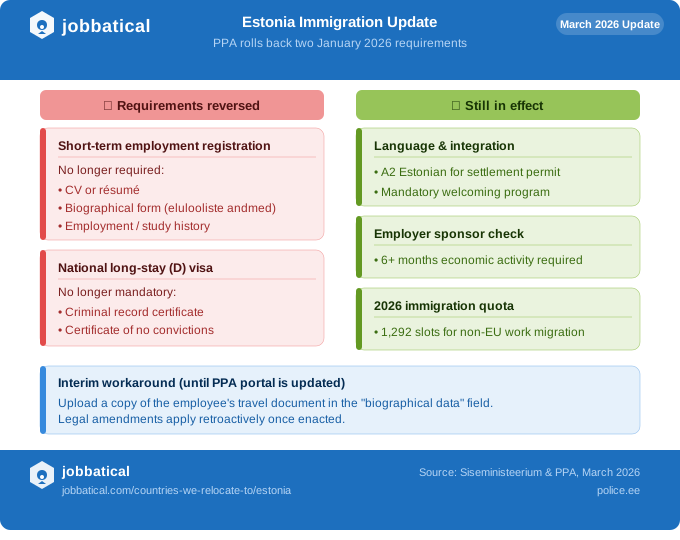
- Short-term employment registration is simpler. Employers no longer need to submit a CV, biographical form, or employment history when registering short-term workers at the PPA — this requirement has been reversed retroactively.
- D-visa applicants get relief. Criminal record certificates are no longer mandatory for national long-stay (D) visa applications; the PPA can still request them case by case, but they are off the default document list.
- Interim workaround is in place. Until the PPA portal is updated, employers should upload a travel document copy in the biographical data field as a placeholder.
- Core 2026 reforms remain unchanged. Language requirements, employer economic activity checks, and quota limits all remain fully in force. Quota Reduction: 1,292 slots for non-EU work/business migration in 2026.
- Changes are retroactive. Legal amendments are being prepared and will apply backdated — HR teams should update document checklists now.
Update: Estonia Rolls Back Two January 2026 Requirements
Last updated: March 2026
Estonia's Ministry of Interior (Siseministeerium) and the Police and Border Guard Board (PPA) have identified friction points in two requirements that took effect on January 1, 2026, and have announced their reversal. The legal amendments are being prepared and will apply retroactively once enacted. Here is what has changed.
Short-Term Employment Registration: No More Biographical Data Required
When an employer registers a foreign national for short-term employment in Estonia via the PPA self-service portal, it is no longer required to submit data about the employee's studies, employment history, or other background details — including the CV, résumé, or the so-called "biographical form" (elulooliste andmete vorm) that became mandatory from January 1, 2026.
The rationale is straightforward: by the time an employer is registering short-term employment, they have already identified the candidate as suitable for the role based on skills and professional background. Requiring the employer to formally re-submit this evidence to the PPA was considered duplicative and operationally burdensome.
Interim step for employers:
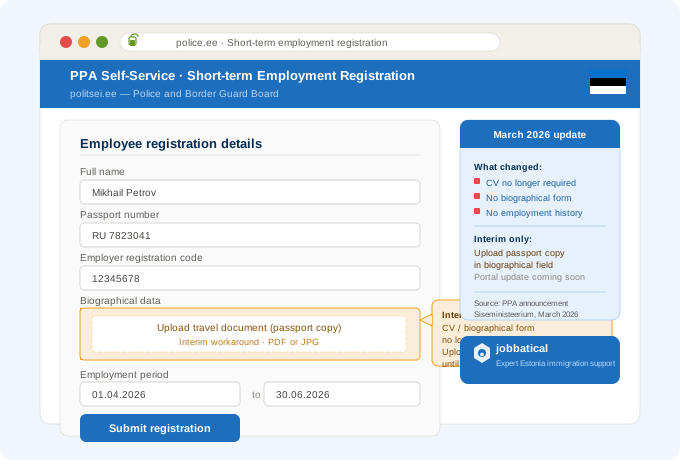
Until the PPA self-service portal is technically updated to reflect this change, the PPA is asking employers to temporarily upload a copy of the employee's travel document in the mandatory "biographical data" field. This is a short-term workaround while the system update is completed.
Estonia PPA self-service portal for short-term employment registration
National Long-Stay (D) Visa: Criminal Record Certificate No Longer Mandatory
When applying for a national long-stay (D) visa in Estonia, applicants are no longer required to provide a criminal record certificate or certificate of absence of criminal convictions from their country of residence or nationality.
This requirement was also introduced on January 1, 2026, but has been reversed. The reasoning reflects proportionality: a D-visa is a temporary basis of stay, and requiring a criminal record certificate at the visa stage — a document that can be difficult and time-consuming to obtain in many countries — was seen as a disproportionate barrier that risked blocking otherwise eligible applicants unnecessarily.
Importantly, the PPA retains the discretion to request this document on a case-by-case basis, as was the practice before January 1, 2026. The change is specifically the removal of criminal record certificates from the mandatory documents list.
What Stays the Same in March 2026
These rollbacks are targeted and narrow. The broader January 2026 reforms remain fully in effect:
Action Points for HR Teams
- Audit active cases: If you have short-term employment registrations in progress where you already submitted biographical data or a CV, no corrective action is needed — registrations remain valid.
- Update your document checklists: Remove the biographical form and criminal record certificate from your standard Estonia short-term employment and D-visa document packs.
- Use the interim workaround: Until the PPA portal is updated, add a travel document copy to the "biographical data" field in the self-service environment when registering short-term employment.
- Monitor for portal updates: The PPA has indicated the system changes are coming shortly and will align with the retroactive legal amendments.
- D-visa applicants: Be aware the PPA may still request a criminal record certificate individually — so having it prepared in advance remains prudent, even if it is no longer submitted by default.
For authoritative confirmation, monitor the PPA website at police.ee and official government communications.
What Changed in Estonia's Immigration Rules for 2026?
Effective January 1, 2026, Estonia introduces stricter criteria for permanent settlement and employment permits to promote integration and verify business legitimacy. Holders of temporary residence permits seeking permanent status must now prove A2-level Estonian language skills and completion of a mandatory welcoming program exemptions apply to applications submitted before year-end 2025 or for permit extensions.
Additionally, the national immigration quota for non-EU nationals in work and business categories is set at 1,292 people, a modest reduction reflecting controlled migration priorities. These measures, outlined in official updates, aim to balance economic needs with cultural integration.
Estonia 2026 immigration document checklist update — what changed
Key Impacts on Employers Hiring Internationally
Businesses sponsoring international talent face new verification hurdles: employers must demonstrate at least six months of prior economic activity to qualify for issuing workforce rentals, short-term work permits, or residence permits tied to employment. This change weeds out speculative hiring and emphasizes sustainable operations.
For HR leaders, this means earlier planning for relocations—anticipate language training timelines, quota competition, and documentation audits. Primary guidance is available on police.ee, Estonia's official Police and Border Guard Board site.
How Jobbatical Simplifies Estonia 2026 Compliance
Jobbatical's technology platform streamlines global mobility for HR teams, providing end-to-end visibility from visa applications through renewals, registrations, and family relocations. Features include automated immigration assessments, next-step alerts, secure document storage, and real-time compliance tracking tailored to Estonia's updates.
- Track progress for every employee and dependent across Europe.
- Automate renewal reminders and legal change notifications.
- Combine AI tools with expert support for 100% compliance.
Backed by 15,000+ successful relocations and world class quality with 4.9/5 excellent rating, we deliver time savings, cost efficiencies, and peace of mind for international hiring and relocation. Try our free work and permit assessment to see how we handle Estonia specifics.
Disclaimer
Immigration rules change often—please verify with official sources or contact us for the latest info before making any decisions.

.svg)