

Business Immigration
Made Simple
  • End-to-end visa and immigration support
  • Expert guidance and tech-powered relocation solutions
  • Tax residency registration and compliance assistance
  • Seamless relocation for employees and their families
Grow with Jobbatical
There was an error
⚠️ Note: We do not assist in job search and Job search queries will not be processed.
There was an error

Thank you for reaching to us!

We will get back to you with more information and the meeting details very soon.

Oops! Something went wrong while submitting the form.
Get a Quote
By registering, you confirm that you have read, understood, and agree to the processing of your personal data as described in our Privacy Notice.
Attention: Be cautious of fake job offers using Jobbatical’s name. Report suspicious activity!
Learn more

Spain Digital Roles 2026: Digital Nomad Visa vs Highly Qualified vs EU Blue Card

5
min read
Last updated
April 15, 2026
Spain Digital roles 2026Spain Digital roles 2026

Key Take aways for Spain Digital role options

  • Three routes, three use cases: Digital Nomad Visa for remote workers staying on foreign payroll; Highly Qualified Worker for standard Spanish employment contracts; EU Blue Card for senior hires above the salary threshold (~€45,000/year).
  • Employer burden scales with seniority: DNV requires minimal employer involvement; HQW and Blue Card require active sponsorship through Spanish immigration authorities.
  • Tech roles get favourable treatment: Spain's shortage occupation list includes many ICT specialisations, waiving or reducing the labour market test for HQW and lowering the Blue Card salary floor to ~€37,500.
  • Blue Card unlocks EU mobility: For companies operating across multiple EU markets, the Blue Card enables internal transfers after 12 months — a strategic advantage for regional talent planning.
  • Plan for 12-week lead times: All routes have official processing windows that frequently extend; build this into hiring timelines from the first candidate conversation.

Hiring digital talent for Spain? You have three viable visa pathways  and choosing the wrong one costs time, money, and sometimes the candidate.

Spain's immigration framework for knowledge-economy workers has matured significantly since the Startup Act introduced the Digital Nomad Visa in 2023. In 2026, employers and HR teams managing relocations to Spain need to understand not just what each permit does, but which profile it was designed for and where the employer's obligations begin and end.

This guide gives you a direct comparison across all three routes so your global mobility team can route candidates correctly from day one.

The Three Pathways at a Glance

Category Digital Nomad Visa Highly Qualified Worker Permit EU Blue Card (Spain)
Best For Remote workers employed abroad Mid-to-senior hires with a Spanish employer Senior specialists, managers
Employer in Spain Required? No Yes Yes
Minimum Salary Threshold ~€2,334/month (2× SMI) No fixed national threshold €45,000+/year (2026 estimate)
Processing Time 20–45 working days 1–3 months 1–3 months
Duration 1 year (extendable to 3) 1 year (renewable) 2 years (renewable)
Family Reunification Yes (from year 1) Yes Yes
Path to Permanent Residency Yes (5 years) Yes (5 years) Yes (5 years, faster with Blue Card chain)
Employer Sponsorship Burden Low Medium High

Which Permit (DNV/ HQP/Blue Card) to Use When
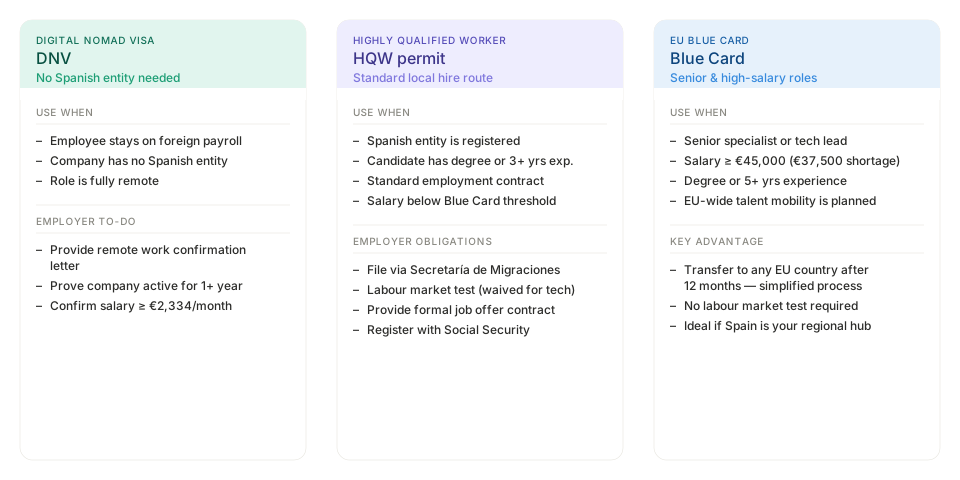
Comparision of Spain Digital Nomad Visa, Highly qualified Permit and EU Blue Card
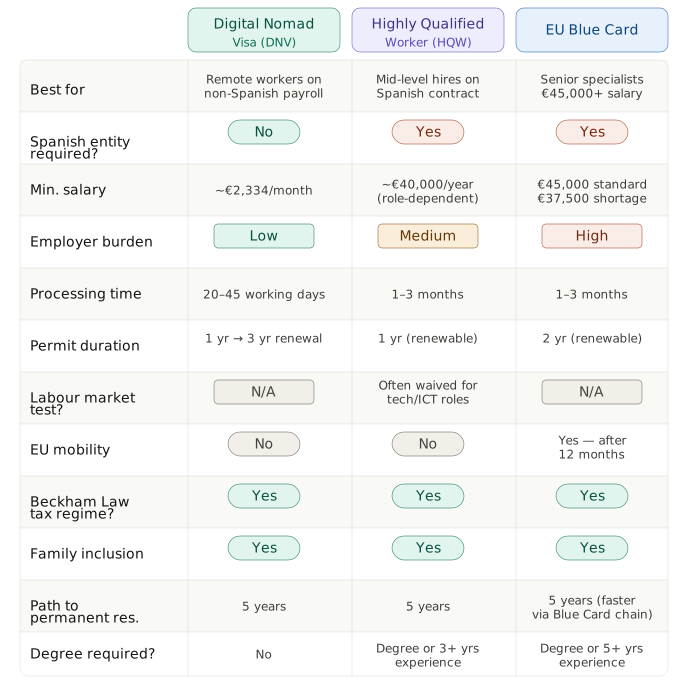
Comparison table of Spain Digital Nomad Visa, Highly Qualified Worker, and EU Blue Card requirements for employers 2026

Matching the Route to Career Stage

A useful mental model for HR teams:

Career Stage Typical Profile Recommended Route
Graduate / Junior (0–3 yrs) Offshore remote hire, no Spanish entity needed Digital Nomad Visa
Mid-level (3–7 yrs) Local hire, Spanish contract, standard salary Highly Qualified Worker
Senior / Specialist (7+ yrs) Senior engineer, tech lead, above-market compensation EU Blue Card
Executive / Director C-suite, board-level Highly Qualified Worker (executive variant) or EU Blue Card

Note: these are default recommendations  individual circumstances (degree requirements, previous permits, nationality) will affect suitability.

Check Complete Guide on Spain Visas Spain Visa Options

Common Employer Mistakes to Avoid

Choosing the DNV for employees you intend to hire locally. The Digital Nomad Visa does not authorise work for a Spanish employer. Using it as a cheaper workaround creates compliance exposure.

Ignoring the labour market test. For the HQW permit, failing to document your shortage occupation exemption properly is the most common cause of delays. Digital and tech roles often qualify  but this must be documented, not assumed.

Missing the Blue Card salary threshold. Some employers benchmark against base salary only. Spain's threshold includes base but the gross annual figure must be verifiable from the employment contract. Bonuses are typically excluded.

Underestimating timelines. All three routes have official windows that often extend in practice. Build a minimum 12-week buffer into your hiring plan for non-EU talent moving to Spain.

How Jobbatical Helps Employers Navigate Spain's Digital Talent Visas

Managing three parallel permit types,  each with different employer obligations, document lists, and authority contacts  is operationally complex at scale.

Jobbatical's Spain immigration experts handle the full permit workflow: from automated candidate eligibility assessment, to document preparation, consulate liaison, and compliance tracking post-arrival. With 15,000+ successful relocations across Europe, our platform gives HR and global mobility teams real-time visibility across every active case.

Disclaimer:

Immigration laws and policies change frequently and may vary by country or nationality. While we strive to provide accurate and up-to-date information, we recommend doing your own due diligence or consulting official sources. You're also welcome to contact us directly for the latest guidance. Jobbatical is not responsible for decisions made based on the information provided.

Spain DNV, Blue Card,HQP

Can an employer in the UK or US sponsor a Spain Digital Nomad Visa?

Not exactly. The Spain Digital Nomad Visa (DNV) is generally an employee-led application, not a classic employer-sponsored work permit. However, the employer still plays an important supporting role by providing a confirmation letter stating that remote work is authorised and that the company has been operational for at least one year. A Spanish legal entity is not required.

What is the minimum salary for the Spain EU Blue Card in 2026?

The salary threshold is approximately €45,000 gross per year for standard roles, and around €37,500 gross per year for shortage occupations. In practice, many ICT, engineering, and digital roles may fall within the reduced threshold category, depending on the official criteria in force at the time of application.

Do Spain Digital Nomad Visa holders qualify for the Beckham Law tax regime?

Yes, in many cases. Spain Digital Nomad Visa holders who become Spanish tax residents may be eligible to apply for the Special Expat Tax Regime (Beckham Law). If approved, this can cap personal income tax at 24% on qualifying employment income up to €600,000, subject to eligibility and filing deadlines.

How long does it take to get a Highly Qualified Worker permit in Spain?

Official processing for a Highly Qualified Worker (HQW) permit is usually around 20–30 working days once the application is submitted. In practice, total timelines are often longer due to document collection, apostilles, translations, and consulate appointment wait times. Employers should usually plan for around 10–14 weeks from offer to legal start date.

Can a Spain Digital Nomad Visa holder later switch to a Spanish employment contract?

Not automatically. The Spain Digital Nomad Visa does not generally authorise standard employment by a Spanish company. If the individual is later hired locally in Spain, they would usually need to switch to a different permit type, such as a Highly Qualified Worker permit or an EU Blue Card, depending on the role and salary.

Is there a labour market test for digital and tech roles in Spain?

In some cases, no. For certain digital, technical, and shortage occupations, the labour market test may be waived or simplified, especially where the role appears on Spain’s official shortage occupation lists or falls under specialised immigration routes. Employers should always verify the specific role and route before relying on an exemption.

What happens to an EU Blue Card if the employee moves to another EU country?

After holding an EU Blue Card in Spain for a qualifying period, the employee may be able to move to another participating EU country and apply for a new EU Blue Card there under facilitated mobility rules. This makes the EU Blue Card especially valuable for employers managing international talent across multiple European offices.

Need help with Immigration services in Spain?

Talk to our experts for industry best employee experience.

Was this helpful?
YesNo
Thank you! Your submission has been received!
Oops! Something went wrong while submitting the form.
Thank you! Your submission has been received!
Oops! Something went wrong while submitting the form.

In this article

    Share